Type a sentence into an AI image generator and seconds later you have a logo, a poster, or a full brand concept. It looks professional. It cost nothing. So the question every business owner is asking in 2026 is fair: if AI can create designs, can it replace a graphic designer?
The honest answer is no — but the honest answer has a second half that matters just as much. AI has already replaced a layer of design work, and the designers who survive are not the ones who ignore it. They are the ones who use it. This post looks at what the 2026 data actually says, what AI still cannot do, and when you should use AI, hire a human, or do both.
What AI is genuinely good at
Give AI its due first. Tools like Midjourney and Adobe Firefly help designers generate logos, fix layouts, and try ten directions in the time one used to take. Junior tasks that once took a day — resizing assets across formats, generating variations, producing first-draft concepts — now take an hour. For a business, that means the bottom layer of design production has been commoditised: a social post, a quick banner, a rough concept to react to — AI does these fast and cheaply. But options are not decisions, and production is not design. That distinction is where the replacement story falls apart.
What the numbers actually say
The data tells a more careful story than the headlines. According to Clutch research, 88% of businesses already use AI design tools in some capacity — yet only 18% of those surveyed said AI tools have reduced their need for designers. A full 74% reported that AI has either not changed their need for graphic design professionals, increased the demand, or replaced only simple graphic design tasks. Just 8% felt it was too early to tell.
The same survey found that when businesses hire designers, creativity ranks as the most valuable trait at 39%, far ahead of strategic thinking (19%), reliability (17%), speed (7%), and affordability (7%). In other words, the thing businesses pay designers for most is the thing AI is worst at.
Designers themselves are adopting the tools fast. GoodFirms reports that 73% of designers now use generative AI in their daily workflow, 70% save over 10 hours per week using AI tools, and AI boosts productivity by 40–70% across design tasks. Figma's State of the Designer 2026 report found 91% of designers said AI improved work quality, 89% said it increased speed, and 80% said it enhanced collaboration. And in a 2025 survey of 500 senior marketing leaders, McKinsey found that human creativity and brand building have only grown in strategic importance as AI adoption accelerates.
Read together, the numbers describe a partnership, not a replacement: AI raises output volume, and then a designer refines the work, adds context, and catches the parts that look off.
What AI still cannot do
Here is where AI keeps falling short, and these are not small gaps.
Brand strategy. AI can generate a logo or a layout in seconds. It cannot build an original brand strategy tied to a company's culture, market, and customers. That work needs real cultural insight into who you are talking to and an emotional read on what the audience actually feels. A model can copy the look of a brand. It cannot decide what the brand should stand for.
Storytelling and client feedback. Design is communication, not just visuals. A designer builds a story through images by talking to the client and reading what they really mean, even when the brief is vague. AI struggles here because it cannot read subjective feedback like "make it pop" and turn it into a clear change. A designer who balances what the client wants with what the brand needs stays hard to replace.
Taste and restraint. Design needs restraint, and AI tends to lack it. A model generates options. It cannot reliably choose what is right for a brand's long-term image, or know when to stop adding elements. Figma CEO Dylan Field has made the same argument in interviews — AI is a tool that amplifies human creativity rather than a threat to it, and while AI lowers the floor for producing work, only humans raise the creative ceiling by making bold, distinctive choices.
Cultural and legal context. AI cannot account for regulatory constraints, because it is generated based on aesthetics and patterns, not legal or ethical requirements. It does not know your past campaigns, your positioning over time, or when a design is technically correct but wrong for your brand. It is also weak at designing for accessibility and readability — the unglamorous requirements that decide whether real people can actually use a design.
High-end and experiential work. Luxury packaging, physical retail spaces, and complex brand systems carry material, cultural, and legal rules that AI cannot fully grasp. The need for human taste and judgment shows up most clearly in this kind of work.
The AI logo trap: when the free design costs you later
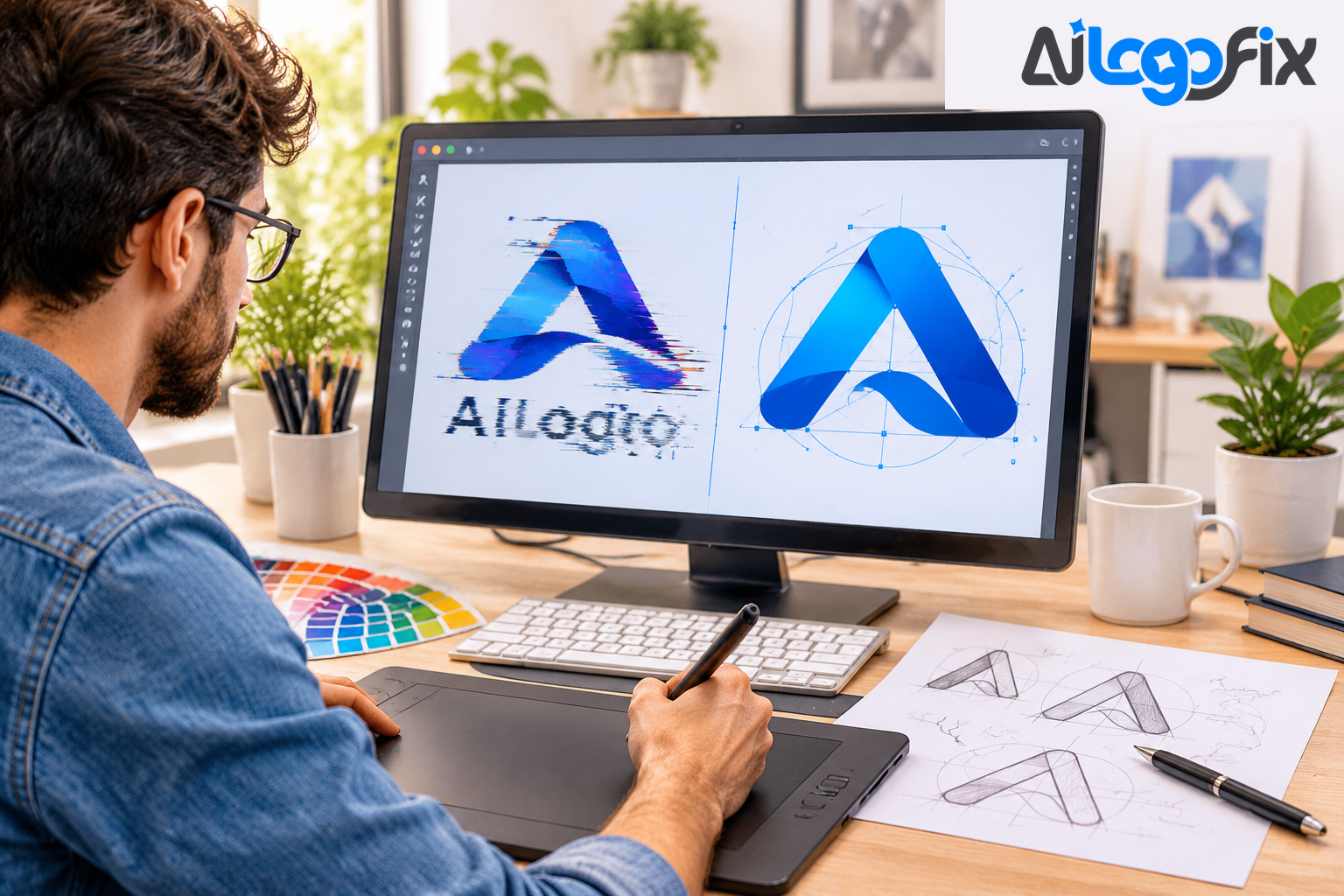
The most common way businesses learn AI's limits is the logo trap. An AI-generated logo looks great at first glance — but it is often generated as a low-resolution, non-vector file that is unusable for print or signage. Zoom in and the problems appear: garbled text, warped shapes, broken symmetry, strange artifacts. The file has no transparent background, no vector paths, and no usable formats.
Businesses that bypass human professionals to create something with AI frequently end up hiring designers later, because their assets are unsuitable for the real world. The "free" logo turns into a paid fix — and often a more expensive one than doing it properly the first time, because the designer has to reverse-engineer a broken concept instead of starting clean.
This is the exact problem AiLogoFix's AI-Generated Logo Fix service exists to solve: human designers take your AI-generated logo and rebuild it properly by hand — real typography replacing the garbled text, crooked shapes corrected, every flaw fixed — and deliver it as a clean, professional vector logo in AI, EPS, SVG, and PDF, from $20. Your AI concept survives; its flaws do not.
The new job: the AI-enabled designer
The profession is not being replaced. It is being split into two groups. One group uses AI as a faster version of what they already did — resizing files quicker, generating stock images faster, automating tasks that were already routine. That group is not being replaced by AI directly. They are being replaced by a single AI-enabled designer who can now do what three used to.
The other group uses AI as a strategic lever: to multiply creativity, accelerate workflows, and increase the value they deliver. They use AI to explore more directions, then apply judgment, brand thinking, and craft to choose and refine. In 2026, the advantage is not using AI — it is how you use it. Designers operating at strategic levels are seeing higher demand and premium pricing, while routine production work shrinks.
For a business hiring design help, this split is the thing to understand. You are not choosing between "AI" and "a designer". You are choosing between cheap production and valuable judgment — and the price difference between them is the price of getting it right.
When to use AI, when to hire a human
- Quick social post or internal graphic: Best choice: AI, then a quick human check
- First-draft concepts to react to: Best choice: AI for options, human to judge them
- A logo for your real business: Best choice: Human designer — or AI concept fixed by a human
- Brand identity, guidelines, rebrand: Best choice: Human, always
- Print, signage, packaging, merchandise: Best choice: Human — files must be production-ready
- Fixing an AI logo's flaws: Best choice: Human designer with vector skills
The rule of thumb: use AI where the cost of being wrong is low, and hire a human where the cost of being wrong is high. A social post can be average. Your logo cannot.
How designers should work with AI
For designers, the practical workflow in 2026 is simple: let AI do the first 70% — the options, the variations, the routine production — and keep the last 30% firmly human. That last 30% is the work that matters: understanding the brief, choosing the direction, fixing what the model got wrong, and delivering files that work in the real world. Without design knowledge to know what to ask AI for, businesses do not necessarily get the result they want. A designer's real value now includes knowing how to prompt, how to judge output, and how to finish it — a skill the flood of AI-generated content has only made more valuable.
FAQ
Will AI replace graphic designers?
No — not according to the 2026 data. Clutch found 88% of businesses use AI design tools, but only 18% said AI reduced their need for designers. AI has commoditised routine production; it has made judgment, taste, and brand thinking more valuable.
What can AI not do in graphic design?
It cannot build brand strategy, interpret vague client feedback, exercise taste and restraint, account for legal and accessibility requirements, or produce production-ready files reliably. AI-generated logos are commonly low-resolution, non-vector, and full of garbled text.
Should I use AI to design my logo?
You can use it for the concept — but do not use the raw output as your logo. It will usually be a flat image you cannot print, scale, or put on a sign. Have a human designer rebuild it as a proper vector logo.
Are designers who use AI better than those who don't?
The data says yes. Figma's State of the Designer 2026 report found 91% of designers said AI improved work quality and 89% said it increased speed. The advantage is in how AI is used, not just whether it is used.
Is it cheaper to use AI instead of hiring a designer?
Up front, yes. In total, often no — because AI output usually needs a human to fix it before it works in print, on signage, or as a brand asset. A logo that has to be rebuilt twice costs more than one done properly once.
Conclusion
AI can create designs, but it cannot replace a graphic designer, because design was never only about creating images. It is about judgment: what a brand should stand for, what a client actually means, what to leave out, and what will work in print, on a sign, or in front of a customer. AI is very good at the first draft and very bad at the last decision — and the last decision is the one you pay for. The designers who thrive in 2026 are not the ones fighting AI. They are the ones using it to do more of the work that only a human can do.
---
Got an AI logo that needs fixing? Our specialist team can help.
Turn Your AI Logo Into a Real Logo — Rebuilt by Hand, From $20
Our designers take your AI-generated logo and rebuild it properly — real typography, corrected shapes, no more garbled text — and deliver it as a clean, professional vector in AI, EPS, SVG, and PDF. Your concept, fixed by humans, with refinements within your selected package and agreed brief.
Want a logo designed from scratch instead? See our custom logo design service — original concepts from $30, plus custom offers. Questions first? Message the team.
---