
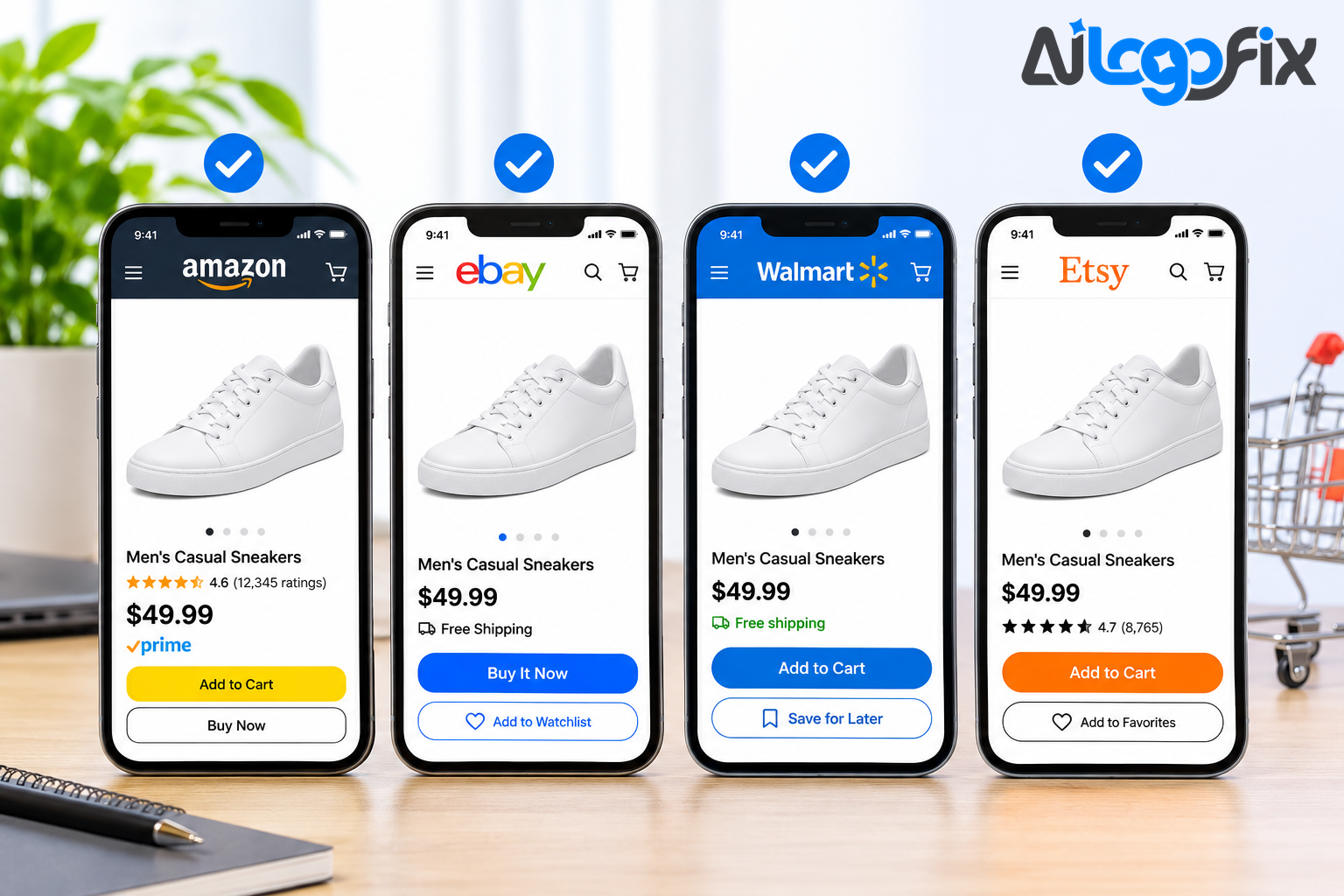
You sell the same product on Amazon, eBay, Walmart, and Etsy. One photo set should cover all four. Instead, each marketplace wants something different: Amazon demands pure white and a product filling 85% of the frame, eBay bans text on every photo, Walmart insists on a square at exactly 2,200 pixels, and Etsy cares most about a 2,000-pixel shortest side and files under 1 MB.
This guide compares all four side by side — the real numbers, checked against each platform's own help pages and current 2026 guides — then shows the one master export that passes everywhere. Shoot once, list four times.
The four platforms at a glance
- Minimum size: Amazon: 500 px longest side; eBay: 500 px longest side; Walmart: 1,500 x 1,500 px for zoom; Etsy: 635 px each side, first photo
- Recommended size: Amazon: 2,000 x 2,000 px (1,600+ for zoom); eBay: About 1,600 x 1,600 px; Walmart: 2,200 x 2,200 px; Etsy: 2,000 px or more, shortest side
- Shape: Amazon: Square main image; eBay: 1:1 or 16:9 look best; Walmart: 1:1 square, required; Etsy: Landscape or square
- File formats: Amazon: JPEG preferred; TIFF, PNG, non-animated GIF; eBay: JPEG, PNG, TIFF, BMP, GIF; Walmart: JPEG, JPG, PNG, BMP (no GIF); Etsy: JPG, GIF, PNG, SVG, HEIC
- Max file size: Amazon: 10 MB; eBay: 12 MB per photo; Walmart: 5 MB; Etsy: Over 1 MB may fail on slow connections
- Photos per listing: Amazon: 9 (1 main + 8 more); eBay: Up to 24, free; Walmart: At least 4; Etsy: Up to 20 photos, 2 videos
- Main image background: Amazon: Pure white, RGB 255, 255, 255; eBay: White or light preferred, not enforced; Walmart: Seamless white, RGB 255, 255, 255; Etsy: No rule; original photos of the item
- Text on images: Amazon: Not on the main image; allowed after it; eBay: Not allowed on any photo; Walmart: No claims or promotional language; Etsy: No rule
Amazon: the strictest main image
Amazon's product image guide is the most detailed of the four, and its main-image rules go beyond size. Every image must run from 500 to 10,000 pixels on its longest side, at 72 dpi minimum, in JPEG, TIFF, PNG, or non-animated GIF. Images under 500 pixels cannot be uploaded, and Amazon warns against artificially enlarging a small image to get past that floor.
Zoom needs more than 1,000 pixels on the longest side; Amazon calls 1,600 pixels or more optimal — the point where zoom is actually sharp rather than merely switched on. The working recommendation is a 2,000 x 2,000 pixel square JPEG: big enough for crisp zoom on any screen, small enough to upload fast.
The main image must show the product alone, fully visible with nothing cut off, filling 85% or more of the frame, on pure white at exactly RGB 255, 255, 255. No packaging, props, text, pricing, or logos. Even a broken white like RGB 250, 250, 250 gets rejected by Amazon's automated checks — a product photographed on a light-grey sweep lands around 246–252 and fails with no explanation. A listing without a compliant main image can be temporarily removed from search. Amazon recommends six more images and a video on top of the main image, with words allowed on those later images — never on the main one.
eBay: the most forgiving on background, the strictest on words
eBay's photo rules are more forgiving than Amazon's — no pure-white mandate — but strict where it counts. Every listing needs at least one accurate photo, at least 500 pixels on its longest side; eBay recommends about 1,600 x 1,600 pixels so zoom works properly. Zoom only activates on larger images — where condition-checking buyers spend their time.
Sellers can add up to 24 photos per listing at no charge, each up to 12 MB; eBay says 1:1 or 16:9 images look best. The hard rules are about what the photo contains: no added borders, text, artwork, marketing material, or watermarks on any photo. Details belong in the title and item specifics, not on the image. Stock photos are only for brand-new items — used items need real photos of the actual item. That last rule catches resellers: the infographics and labelled images you use on Amazon do not belong on eBay. Plain photos do.
Walmart: the square that will not bend
Walmart Marketplace US lists square 2,200 x 2,200 pixel images in 8-bit RGB — JPEG, JPG, PNG, or BMP files no larger than 5 MB. It sets 1,500 x 1,500 pixels as the zoom minimum, and calls for a seamless white main-image background at RGB 255, 255, 255. The 2,200 value and the 1,500 zoom threshold answer different questions: 2,200 is Walmart's listed image size, 1,500 the minimum for zoom to work.
Walmart is the only one of the four that makes 1:1 square a hard rule rather than a recommendation — it will not pad a near-square image for you. Upload a rectangle and it gets cropped or rejected. At least four distinct images per listing are recommended: a main white-background shot, a lifestyle image, a detail close-up, and a graphic with key information. Images must not include claims or promotional language, other retailers' names or logos, or any language other than English. AI-generated images are allowed, but must be truthful, accurate, rights-compliant, and not misleading. Non-compliant listings are unpublished automatically until corrected — which is why 2,200 x 2,200 is a requirement, not a nice-to-have.
Etsy: the 2,000-pixel shortest side and the 1 MB trap
Etsy's image requirements page recommends listing photos of at least 2,000 pixels on each side. The first listing photo needs at least 635 pixels on each side, or the listing can rank lower in search. Etsy recommends 2,000 pixels or more on the shortest side, because that is where zoom lives: a 2,000-pixel image holds together when a shopper hovers or pinches, and a 900-pixel image does not.
Each listing takes up to 20 photos and 2 videos (3–15 seconds, up to 100 MB, no sound). File types are JPG, GIF, PNG, SVG, and HEIC — but animated GIFs are not supported, and transparency is not either: transparent parts of a PNG show up black on Etsy, so never upload a print file as a listing photo.
Two Etsy traps catch sellers who come from Amazon. First, the file weight: Etsy warns that images over 1 MB may not finish uploading on a slow connection, so a JPG at 80–90% quality is the practical target even though the formal cap is higher. Second, the crop: Etsy displays listing images in 4:3, 3:4, and 1:1 crops depending on whether a buyer browses on mobile, desktop search, or your shop page. Etsy support recommends a 2,400 x 2,400 pixel square for maximum flexibility across all three crops, with the product centred and generous spacing.
One shot, every marketplace
Here is the master export that passes all four: a square 2,200 x 2,200 pixel JPEG on pure white, under 5 MB. It meets Amazon and Walmart's size and background rules and eBay and Etsy's size recommendations. It is the size Walmart specifies, over Amazon's 1,000-pixel zoom threshold and inside its 10,000 maximum, over eBay's 1,600 recommendation, and over Etsy's 2,000-pixel shortest side.
From that master, export four copies:
1. Amazon: 2,000 x 2,000 px square JPEG, pure white, product filling 85% or more, no text on the main image. Keep a word-free version for the main slot. 2. eBay: 1,600 x 1,600 px square JPEG, plain photo, no text, borders, or watermarks — use the word-free version for every slot. 3. Walmart: the master itself — 2,200 x 2,200 px square JPEG, pure white, under 5 MB, no claims or promotional language, no other retailer's name or logo. 4. Etsy: 2,000 px on the shortest side, saved at 80–90% JPEG quality to stay under about 1 MB, product centred with generous spacing so the 4:3, 3:4, and 1:1 crops all work.
Shoot the master with space around the product for later crops. Check colour against the real product, save in sRGB, and keep the word-free version as your base — adding words later for Amazon and Etsy is easy, but removing them for eBay and Walmart means starting over.
Getting the background truly white is the step most sellers skip — and the one that causes the silent rejections. AiLogoFix's background removal service puts product photos on a pure white background by hand at exactly RGB 255, 255, 255, so the same master file passes Amazon and Walmart first time. If the listing also needs a clean logo for packaging or inserts, the raster to vector service turns it into a scalable vector. For details, see Background Removal for Amazon Product Images, Etsy Product Photos: Background Removal That Sells, and What Is a Print-Ready Logo?
FAQ
What size should my product images be for all four?
A square 2,200 x 2,200 pixel JPEG on pure white, under 5 MB — Walmart's specified size, clearing Amazon's zoom threshold, eBay's 1,600 recommendation, and Etsy's 2,000-pixel shortest side. Export smaller copies from that master.
Why was my Amazon listing removed from search?
The most common reason is a non-compliant main image: a background that is not exactly RGB 255, 255, 255, a product filling less than 85% of the frame, text or a logo on the main image, or an image under 500 pixels long. Fix the main image and the listing returns.
Can I use the same images with text callouts on eBay?
No. eBay bans added text, borders, artwork, marketing material, and watermarks on every photo. Keep a word-free version of every image for eBay; use callout versions only on Amazon's later slots and Etsy's gallery.
Why do my Etsy photos look cropped in search?
Etsy displays listing images in 4:3, 3:4, and 1:1 crops depending on the device and page. Upload a 2,400 x 2,400 pixel square image with the product centred and generous spacing around the edges, and all three crops stay clean.
Conclusion
Amazon, eBay, Walmart, and Etsy disagree on almost everything — size, shape, background, words, file cap. The way through is not four separate photo shoots: one master file, 2,200 x 2,200 pixels, square, pure white, under 5 MB, shot with space around the product, and four exports from it. Keep the background white, keep text off the images eBay and Walmart will see, and keep Etsy copies under a megabyte — one set of photos lists everywhere, first time.
Selling on Amazon, eBay, Walmart, and Etsy?
AiLogoFix's specialist team puts your product photos on a true pure-white background by hand, checks every edge, and delivers listing-ready images sized for all four marketplaces — so one set of photos passes everywhere, first time.
Get Your Product Photos Marketplace-Ready · Message the team