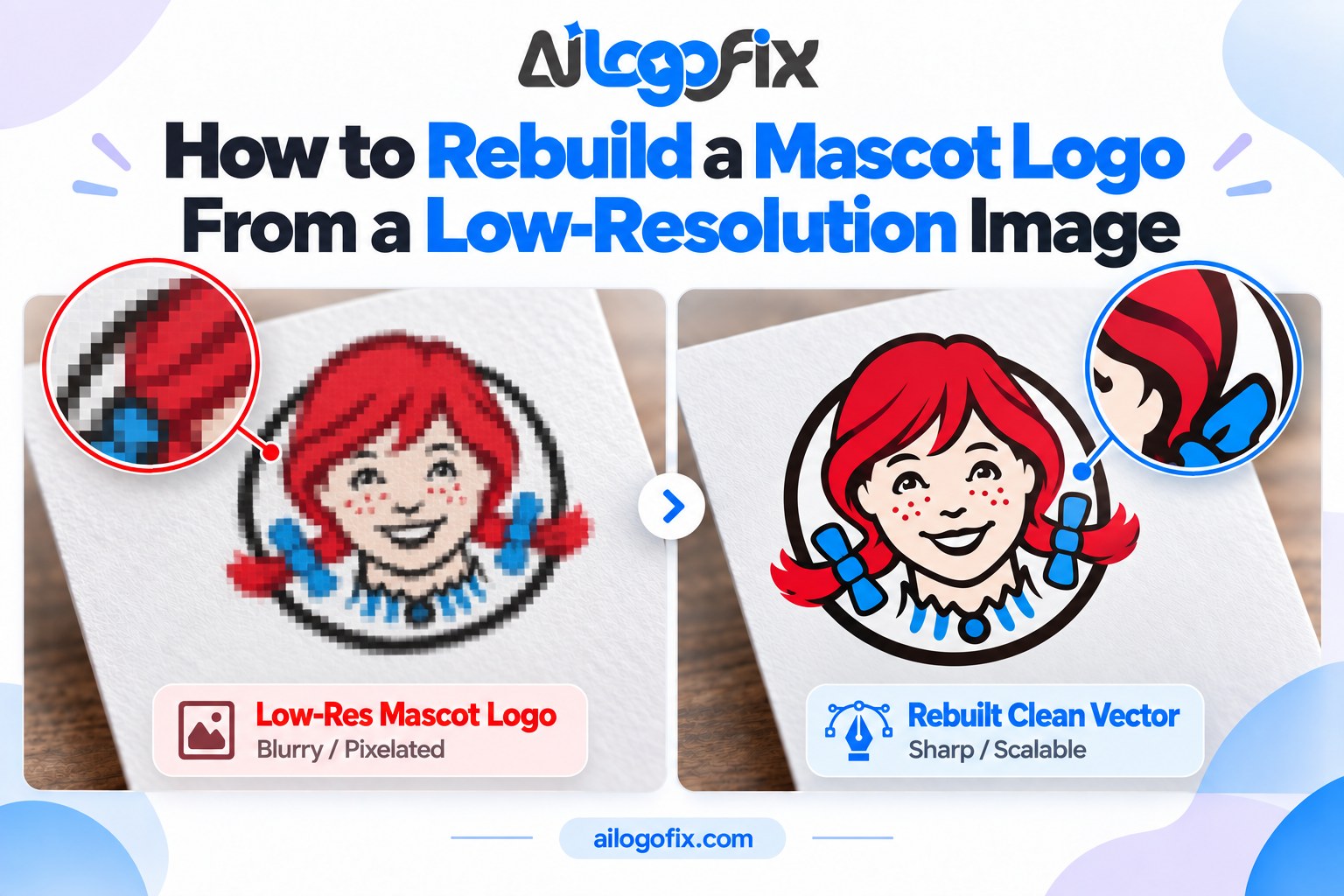
How to Rebuild a Mascot Logo From a Low-Resolution Image
Your mascot logo exists only as a tiny, blurry image — a 20-year-old JPG, a screenshot, a scan of a printed shirt. You need it big, clean, and usable. Here is the problem: rebuilding a mascot logo from a low-resolution image is one of the hardest jobs in vector work, because mascots are packed with the exact details that low resolution destroys.
In This Guide
- Why Mascots Are the Hardest Logos to Rebuild
- The Rebuild Process: What Actually Happens
- What You Should Provide
- Realistic Expectations
- FAQs
- Rebuild Mascot Logo: Complete FAQ
- 6 Rebuild Mascot Logo Mistakes and How to Fix Each
- Pro Tips for a Flawless Mascot Rebuild
- When to Hire a Designer to Rebuild Your Mascot Logo
- Mascot Rebuild Glossary
Quick answer: A low-res mascot cannot be “enhanced” into a good logo — it must be manually redrawn as a vector. A designer interprets the blurry reference, reconstructs every detail (eyes, fur, shading, text), and rebuilds it as clean, scalable artwork. Expect mascot logo vectorization to take longer than a simple logo, and be ready to answer questions about details the image no longer shows.
Why Mascots Are the Hardest Logos to Rebuild
A wordmark is shapes and letters. A mascot is a character — faces, expressions, fur or feathers, clothing, shading, sometimes text wrapped around it. Low resolution destroys exactly these fine details: eyes become blobs, fur texture becomes noise, thin outlines vanish. That is why mascot logo vectorization is skilled illustration work, not a one-click conversion.
Worse, every viewer knows what a face should look like. A slightly wrong wordmark still reads fine; a slightly wrong mascot face looks creepy or broken. The rebuild has to be not just clean, but right — faithful to the original character.
This is also why auto-trace fails hardest on mascots: it converts blur into jagged noise and calls it a vector. See manual vs auto trace for the full comparison.
The Rebuild Process: What Actually Happens
Step 1: Study the reference
The designer examines your low-res image at maximum zoom, identifying every element: the character’s pose, facial features, clothing, text, colors, and overall composition. Anything unclear gets flagged for your input.
Step 2: Fill the gaps with your input
This is the step owners do not expect. Your blurry image might not show what color the mascot’s eyes are, how many fingers it has, or what the small text says. The designer will ask — because guessing wrong means rebuilding wrong. Have any other versions handy: old shirts, signs, business cards, even photos of the mascot in use.
Step 3: Redraw the character
Using the reference as a guide, the designer redraws the mascot as clean vector paths: smooth outlines, rebuilt facial features, reconstructed details. This is illustration work, not tracing — the designer is effectively re-drawing your character with professional precision.
Step 4: Rebuild text and effects
Any lettering is retyped and matched (see how designers fix logo lettering). Shading and gradients are rebuilt as clean vector effects — or simplified if the logo needs to work in single color for embroidery or vinyl.
Step 5: Simplify for real-world use
A detailed mascot often needs a simplified version for small sizes and single-color applications (embroidery, engraving, fax). A good rebuild delivers both: the full-detail master and a cleaned-up version that survives tough reproduction.
What You Should Provide
Every version you can find. The blurry JPG plus anything else: photos of signage, old merchandise, printed materials, social media avatars. Different versions reveal different details.
The story. What is the mascot? What should it express? What colors is it supposed to be? Your knowledge fills gaps the pixels cannot.
Text content. Exact wording, spelling, and capitalization of any text in or around the mascot.
End use. Where will the rebuilt logo go? Print, embroidery, and signage each need different preparation — embroidery especially needs simplification.
Realistic Expectations
It takes longer than a simple logo. A mascot rebuild is illustration work. Rushing it produces a character that looks “almost” like yours — which is worse than an obvious redraw.
It may not be pixel-identical. Where the original detail is truly gone, the designer makes professional judgment calls. Review rounds exist for exactly this — you approve the interpretation before it is final.
It is worth it. A properly rebuilt mascot becomes a permanent asset: scalable to billboard size, clean enough for embroidery, consistent across everything. The blurry JPG was a liability; the vector rebuild is an asset.
We Rebuild Mascot Logos From Any-Quality Images
Send us your blurry, tiny, or damaged mascot image — our designers will redraw it as a clean, faithful vector logo, fill in the missing details with your input, and deliver the complete professional file package.
FAQs
Can you rebuild my mascot logo from a blurry photo?
Yes — blurriness is the normal starting point for mascot rebuilds. What matters is that the overall character, pose, and composition are recognizable. Fine details get reconstructed with your input.
Will the rebuilt mascot look exactly like the original?
Faithful, not pixel-identical. Where the original detail survives, it is matched; where it is lost to blur, the designer reconstructs it professionally and you approve the result in review rounds.
Why can’t software just enhance my low-res mascot?
Upscalers invent detail — they guess. On a mascot face, a wrong guess means wrong eyes, wrong expression, wrong character. Only a human designer can reconstruct your actual mascot faithfully.
How long does a mascot rebuild take?
Longer than a simple logo — it is illustration work, typically measured in days rather than hours, plus review rounds. The complexity of your character is the main factor.
Can the rebuilt mascot be embroidered?
Yes, with simplification. Embroidery cannot reproduce fine detail, so a good rebuild includes a simplified single-color version alongside the full-detail master.
What if I have no reference image at all?
Then it is a design project, not a rebuild — the mascot gets designed fresh from your description. That is a different service; message us and we will point you the right way.
The bottom line: A low-resolution mascot is not a dead end — it is a starting reference. With a skilled redraw, your character comes back sharper, cleaner, and more versatile than it ever was, ready for everything from favicons to billboards.
Rebuild Mascot Logo: Complete FAQ
Everything you need to know to rebuild mascot logo artwork from a low-resolution image, answered by designers who do this work every day. If your mascot looks blurry, pixelated, or outdated, this rebuild mascot logo FAQ shows the path back to crisp.
What does it mean to rebuild a mascot logo?
To rebuild mascot logo artwork means recreating it as clean, scalable vector art from whatever source you have, usually a small JPG, PNG, or screenshot. Unlike simple auto-tracing, a true rebuild mascot logo process redraws every curve, expression, and detail by hand so the character looks intentional at every size. The result is a master vector file that scales from favicon to billboard without losing the mascot’s personality. When you rebuild mascot logo files properly, you also fix years of accumulated damage: compression artifacts, fuzzy edges, and distorted proportions all get corrected in the redraw.
Can a mascot be rebuilt from a very small image?
Yes, within reason. Designers routinely rebuild mascot logo art from images as small as 300 pixels wide, because the redraw relies on the designer’s eye as much as the source pixels. The key is that the mascot’s essential features must be visible: eyes, mouth, defining shapes, and color regions. When you rebuild mascot logo artwork from tiny sources, the designer interprets blurry areas using knowledge of anatomy, cartooning conventions, and your brand context. Extremely degraded images may need reference photos or your verbal guidance to fill gaps, but a skilled designer can rebuild mascot logo characters from surprisingly little.
How long does it take to rebuild a mascot logo?
Most rebuild mascot logo projects take 2 to 5 business days depending on complexity. A simple cartoon face with flat colors might be done in 48 hours, while a detailed full-body mascot with shading, texture, and multiple poses takes longer. When you rebuild mascot logo artwork professionally, the timeline includes the initial redraw, your revision rounds, and final file preparation in all formats. Rush service is often available for deadlines. Be wary of anyone promising to rebuild mascot logo files in an hour; quality redrawing cannot be rushed without losing the character’s charm.
Will the rebuilt mascot look exactly like the original?
It will look like the original was always supposed to look. A professional rebuild mascot logo service preserves the character’s identity, expression, colors, and proportions while cleaning up everything degradation added. Think of it as restoring a classic car: same model, same personality, but every panel straight and the paint gleaming. When you rebuild mascot logo art, minor inconsistencies in the original (asymmetric eyes, wobbly outlines) get subtly corrected. The mascot remains recognizably yours, just sharper, cleaner, and more professional at every size.
What files do I get when I rebuild a mascot logo?
A complete rebuild mascot logo package includes vector masters (AI, EPS, SVG, PDF) plus web-ready exports (PNG with transparency, JPG) and often a print-ready CMYK version. The vector files are the real deliverable: infinitely scalable, fully editable artwork. When you rebuild mascot logo files with a professional service, ask specifically for layered source files so future designers can edit individual elements. Also request the color builds (Pantone, CMYK, RGB, HEX) documented, since mascot colors are brand assets worth protecting.
Is auto-trace good enough to rebuild a mascot logo?
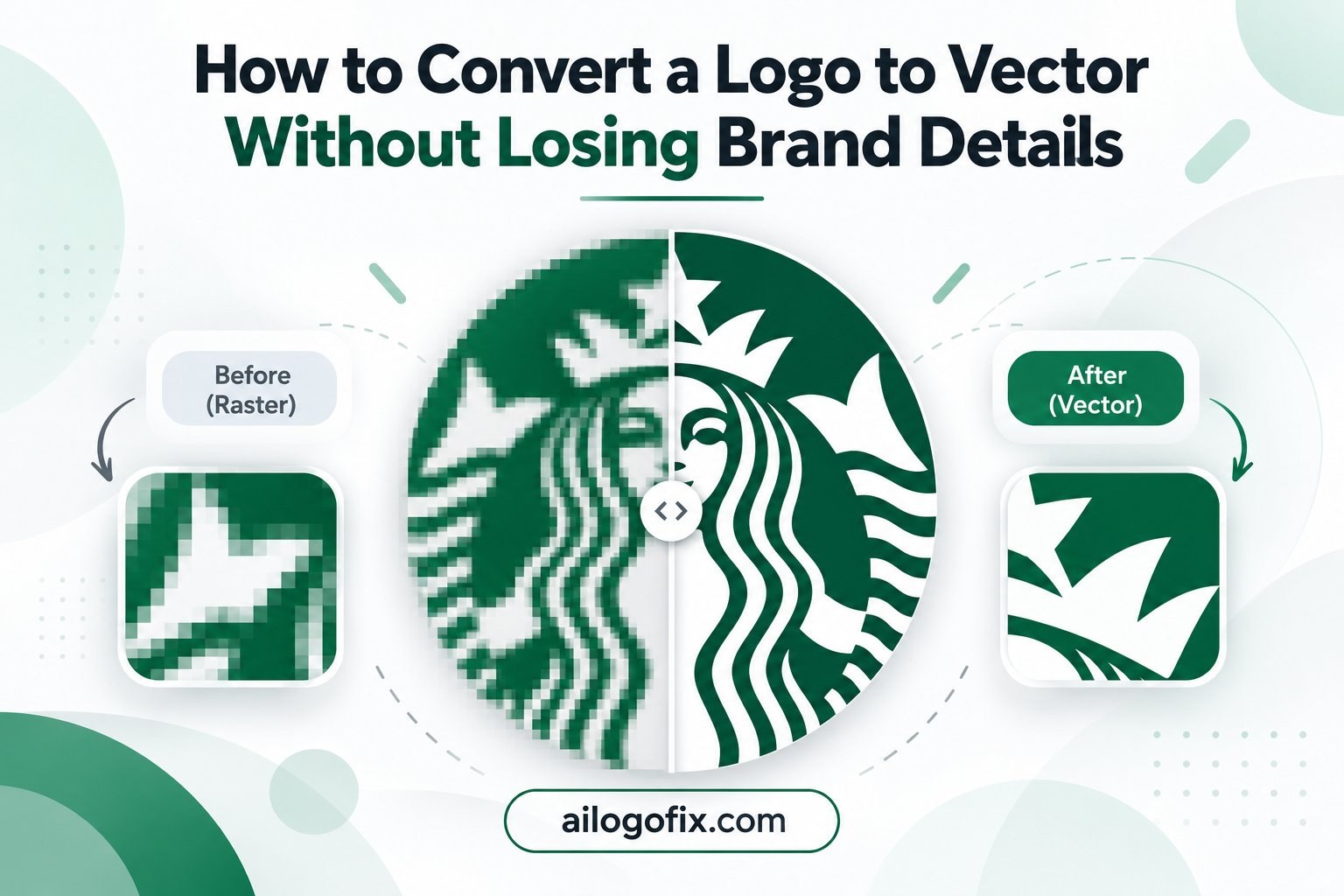
No. Auto-trace follows pixels, and low-resolution pixels are exactly what is wrong with your source. When you rebuild mascot logo artwork with auto-trace, you get thousands of jagged anchor points, lumpy curves, muddy color blends, and lost facial expressions. Mascots live or die on clean curves and expressive features, which only a human hand redraws well. Manual rebuild mascot logo work produces smooth bezier curves, deliberate color separations, and a character that looks designed rather than processed. Auto-trace is fine for simple geometric shapes; mascots need an artist.
How much does it cost to rebuild a mascot logo?
Professional rebuild mascot logo service typically ranges from $30 to $150 depending on detail level, with most standard mascots in the middle of that range. Simple face-only mascots cost less; full-body characters with complex shading cost more. When you rebuild mascot logo artwork, you are paying for skilled illustration time, not just file conversion. Compare that against the cost of a blurry mascot undermining your brand on every package, uniform, and advertisement. A proper rebuild mascot logo is a one-time investment that pays off for years.
6 Rebuild Mascot Logo Mistakes and How to Fix Each
Avoid these rebuild mascot logo errors that ruin otherwise good characters.
1. Tracing instead of redrawing. Running auto-trace and calling it a rebuild mascot logo job produces lumpy, lifeless art. Fix: insist on manual vector redrawing where every curve is placed deliberately. Ask to see the wireframe view; smooth, economical anchor points prove real rebuild mascot logo craftsmanship.
2. Losing the character’s expression. A mascot’s wink, grin, or raised eyebrow is its brand equity. Careless rebuild mascot logo work flattens expressions into generic cartoon faces. Fix: provide the clearest expression reference you have and require the designer to match it. Review the face at large size before approving; if the personality is gone, the rebuild mascot logo has failed.
3. Wrong or shifted colors. Eyedropper-picking colors from a compressed JPG bakes in compression artifacts. Every rebuild mascot logo needs deliberate color decisions. Fix: supply official brand colors as Pantone or HEX values. If none exist, have the designer sample from the cleanest area and then refine to a sensible palette, documenting every rebuild mascot logo color build.
4. Ignoring small-size legibility. A mascot rebuilt only for large display turns to mush as a favicon or embroidery. Fix: every rebuild mascot logo should be tested at 16 pixels, 1 inch, and full size. Simplify tiny details that vanish at small sizes, and consider a simplified secondary version for tiny applications.
5. Forgetting the transparent background. Rebuilding on a white box defeats the purpose when the mascot must sit on photos or colored backgrounds. Fix: specify transparent PNG and true vector cutout in your rebuild mascot logo brief. Verify the final files have genuinely transparent backgrounds, not white rectangles.
6. Accepting a single file format. A JPG-only delivery is not a rebuild mascot logo; it is a prettier raster. Fix: require vector masters (AI, EPS, SVG) plus web and print exports. Without editable vector source, you will pay to rebuild mascot logo files all over again next time.
Mascot design has deep roots in branding history: what makes a mascot work and why vector graphics matter for logos.
Pro Tips for a Flawless Mascot Rebuild
Elevate your rebuild mascot logo project with these professional practices. First, gather every version of the mascot you can find before the redraw starts: old business cards, uniforms, vehicle photos, website screenshots. Multiple references help the designer triangulate the true design when each source is degraded differently. The best rebuild mascot logo results come from rich reference, not a single blurry file.
Second, decide on style refinements upfront. A rebuild mascot logo is the perfect moment to modernize slightly: clean up outdated shading, simplify fussy details, sharpen the silhouette. List exactly what should stay identical (the grin, the hat, the colors) and what may improve. This turns a simple rebuild mascot logo job into a strategic brand refresh.
Third, build a mascot usage system, not just a file. Request full-body, face-only, and icon versions from your rebuild mascot logo project, plus monochrome and reversed variants. Mascots work hardest when adapted thoughtfully to each context, from embroidered caps to app icons.
Fourth, protect the master files. Store your rebuilt vector masters in two places, document the color builds, and note the designer’s contact. Future you will thank present you when the next vendor asks for the vector mascot and you deliver it in seconds.
When to Hire a Designer to Rebuild Your Mascot Logo
Some projects reward DIY; mascot rebuilding is rarely one of them. Hire a professional to rebuild mascot logo artwork when the character matters to your brand.
Your mascot is your brand face. Restaurants, sports teams, and children’s brands live or die by mascot recognition. A professional rebuild mascot logo protects that equity with clean, expressive, faithful artwork.
You need it for print and merchandise. Embroidery, screen printing, and vehicle wraps demand precise vector files with limited colors. Rebuild mascot logo specialists prepare exactly that.
The source is badly damaged. When the only reference is a faded photo of a van, you need an illustrator’s judgment, not software. Our raster to vector service includes full manual mascot rebuilding.
Ready for a mascot that looks sharp everywhere? Message our design team and we will rebuild mascot logo files you will be proud of.
Mascot Rebuild Glossary
Terms you will hear during a rebuild mascot logo project:
Redraw: Manually recreating artwork with vector paths, the heart of any rebuild mascot logo job.
Anchor point: Control points defining vector curves. Fewer, well-placed points mean cleaner art.
Bezier curve: The mathematical curve behind smooth vector outlines.
Silhouette: The outer shape of the mascot. A strong silhouette stays recognizable even in solid black.
Flat color: Solid unshaded color areas, ideal for embroidery and vinyl.
Gradient mesh: Complex vector shading technique for realistic depth in rebuilt mascots.
Line art: The black outline structure beneath mascot colors.
Pose sheet: A set of mascot poses and expressions derived from the master rebuild.
Brand mascot: A character representing a company, rebuilt to stay consistent across all media.
Bottom line: To rebuild mascot logo artwork right, insist on manual redrawing, protect the character’s expression, lock down official colors, and demand true vector masters. A faithful rebuild mascot logo turns your blurriest asset into your sharpest brand tool.